


Ethiopia
Cadence Espresso
Cadence Espresso
Natural / Dry
Heirloom
2200 - 2350
Regular
Couldn't load pickup availability

Roasted and dispatched by Clifton Coffee Roasters.
Only roasters we’d buy from our selves. One checkout to reach them all.


What to Expect
This is Clifton Coffee Roasters' Cadence Espresso, a natural Ethiopian from Guji that brings black cherry sweetness and a surprising Earl Grey floral lift. It's fruit-forward without tipping into funky territory, roasted for espresso but with enough clarity to show off its high-altitude origins.
The Cup
The body is indulgent and syrupy, thanks to the natural process and the careful drying regime at Dogo Sodu. Acidity is moderate and rounded rather than sharp, with a malic, cherry-like brightness that doesn't bite. This is a clean natural, not a wild one. The ferment character is present but restrained, giving you dried fruit sweetness and a touch of boozy depth without veering into polarising funk. That bergamot-like Earl Grey note adds a floral complexity that lingers after the cup.
Who This Is For
This suits espresso drinkers who want fruit and sweetness without sacrificing body, and it works beautifully in milk where it rounds out into rum raisin richness.
If you prefer bright, tea-like filter coffees or dislike any hint of fermented fruit character, this won't be your speed.
Best for: Espresso lovers who like their shots fruity, full-bodied, and milk-friendly.
How to Brew This Coffee
It's roasted for espresso, where that syrupy body and black cherry sweetness really shine, especially in milk-based drinks. The Aeropress will give you a concentrated, espresso-like cup with good clarity if you don't have a machine. A Moka pot will emphasise the chocolate and dried fruit depth, leaning into the natural process richness.
Ethiopia
Cadence Espresso

We enhance these descriptions ourselves and check them by hand, but mistakes can happen. The roaster's own wording is shown below. If anything arrives not as described, contact us and we'll put it right.

Description from Roaster
Our latest iteration of Cadence Espresso comes from the Dogo Sodu processing facility, just outside the town of Gerba in Ethiopia's Guji Zone, run by Gemechu Shonora alongside his brothers Shebura, Morkata and Adugna. Their father spent years working as a coffee collector in...Description from Roaster
 Our latest iteration of Cadence Espresso comes from the Dogo Sodu processing facility, just outside the town of Gerba in Ethiopia's Guji Zone, run by Gemechu Shonora alongside his brothers Shebura, Morkata and Adugna. Their father spent years working as a coffee collector in the area, travelling between the surrounding villages to buy cherry from local farmers, and that relationship has carried through into the mill their sons now run. Cherry for this lot is sourced from smallholders in Gerba Layo, at altitudes between 2,250 and 2,350 masl.
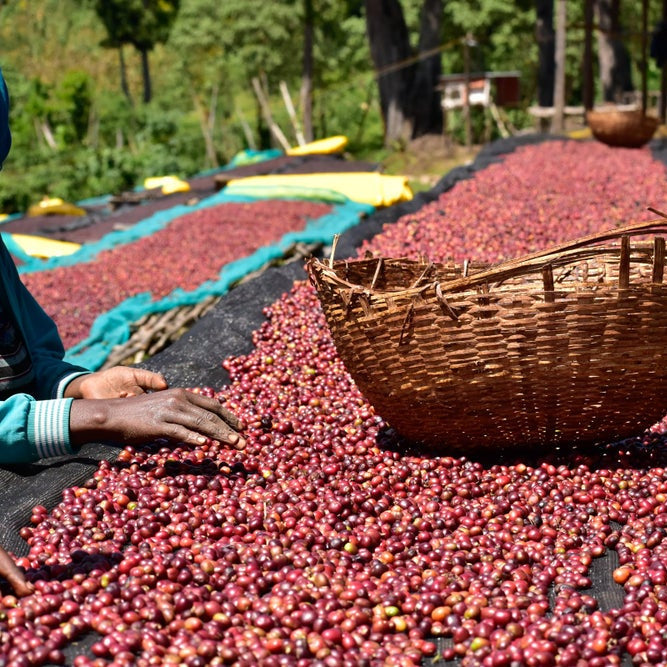
Every delivery of cherry is first floated in water to separate out any underripe or defective coffee, with only the ripest cherries carried forward. The selected cherries then go straight onto raised drying beds, spending three days in full sun before moving under shade cover for a further fifteen days, drying slowly and evenly to protect the fruit character developed during processing. Throughout this period, workers hand-sort the beds to remove any visible defects, which is what allows the family to consistently produce quality lots.This natural processed coffee has the fruit forward intensity the Guji region is known for, with a black cherry sweetness that sits at the front of the cup and carries through into a rich, baker's chocolate depth with a gentle Earl Grey character, lending a floral, bergamot-like lingering characteristic. In milk, that same sweetness rounds out into something closer to rum raisin ice cream. Boozy dried fruit and cream, with the natural process fermentation giving an indulgent body.Our Cadence Espresso changes seasonally, showcasing standout coffees from around the world. Expect something new every 3-6 months.
Recommended recipe: 18g dose - 40g yield in 28-30 seconds.This description comes from Clifton Coffee Roasters UK, who roasts this coffee. For the fullest product detail, you can also see their own listing at Clifton Coffee Roasters
Ways to Brew
-

Espresso
Coffees hand-picked for espresso, chosen by analysing each one's roast, body and flavour rather than relying on the roaster's label. These are beans with the sweetness, depth and structure to pull a rich, balanced shot under pressure, from chocolatey blends to fruit-forward single origins. Every coffee here earned its place by how it actually performs in the basket. New to pulling shots? Read our espresso brewing basics.
-

Aeropress
A curated range of coffees suited to the Aeropress, selected on their own merits through our attribute analysis. We look for the clarity and balance this fast, pressure-assisted method rewards, so whether you brew short and concentrated or long and clean, each bean here is chosen to give you a bright, well-defined cup. Want to get the most from yours? See our Aeropress brewing guide.
-

Moka
Coffees curated for the moka pot's concentrated, stovetop intensity, each assessed for how it stands up to high-heat brewing. We look for robust body and low-acidity sweetness that carry through this method, delivering the strong, espresso-adjacent cup the moka pot is known for. First time brewing? Read how to use a moka pot.


Clifton Coffee Roasters
Founded in 2001 in Bristol, Clifton Coffee began as a specialist service provider for espresso machines supporting the city’s independent coffee businesses. As the company grew, it expanded into coffee wholesale, helping to supply high-quality coffee to a growing network of customers. Ahead of its time, Clifton Coffee also introduced barista training to support its partners, helping to raise standards across the independent coffee scene and reinforce its commitment to quality, education, and long-term customer relationships.
Shop Clifton Coffee Roasters